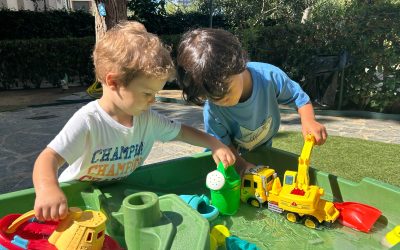
The foundation of the feeling “I can do it.”
Early childhood is a critical period in which children learn to solve problems through small challenges that carry enormous developmental meaning as they explore the world. Sharing a toy, watching a structure collapse, waiting for a turn, or not having a wish fulfilled immediately… Each of these is a problem for a child, and at the same time, a powerful learning opportunity.
As adults, solving every problem on behalf of children may feel relieving in the short term, but in the long run it limits the development of self-confidence, resilience, and independence. The goal is not to prevent children from struggling — the goal is to support them through struggle. Because problem solving is the foundation of the journey from “I can’t” to “Let me try.”
Which Developmental Areas Does Problem Solving Support?
Problem-solving is not only a cognitive process; it nourishes multiple areas of development simultaneously.
- Cognitive development: understanding cause–effect relationships, thinking of alternatives
- Emotional development: tolerance for frustration, patience, emotional regulation
- Social development: waiting, sharing, negotiating, empathy
- Self-confidence: belief in “I can try” and “I don’t give up even when it’s hard”
For this reason, problem solving shapes not only a child’s present behavior, but also their future life skills.
The Path from “I Can’t” to “Let Me Try”
The Link Between Problem Solving and Self-Confidence
When a child is rescued by an adult every time they struggle, they receive the message:
“I cannot do this on my own.”
But when space is created for them to try and their effort is acknowledged, a different message grows stronger:
“I struggled, but I can keep trying.”
Self-confidence is not born from perfect success; it grows from the courage to attempt. The problem-solving process builds a child’s belief in themselves step by step.
Why Is Early Problem Solving Critical?
Problem-solving skills developed in early childhood directly affect:
- school adjustment
- academic learning
- peer relationships
- coping with stress
The earlier this skill is supported, the more flexible and resilient a child becomes in the face of future challenges.
Before Problem Solving: Regulating Emotion
Can There Be a Solution Without Emotional Regulation?
When a child is overwhelmed by strong emotions, the part of the brain responsible for problem solving (the prefrontal cortex) cannot function effectively. Expecting “logical solutions” from a crying, angry, or defeated child is unrealistic.
The first step is to notice and name the emotion:
- “You’re really angry right now.”
- “That was hard for you, I understand.”
A child whose emotions are regulated becomes much more open to solutions.
Are Moments of Crying, Anger, and Giving Up Learning Opportunities?
When supported correctly, these moments are among the most valuable moments of development.
Crying, anger, or giving up are often not signs that a child is “difficult” or “stubborn,” but signs that their current skills are not yet sufficient for the situation. In those moments, the child is essentially saying:
“I’m having trouble managing this on my own.”
What matters is not suppressing the emotion, but using language that accompanies it.
Instead of saying “Stop exaggerating”, “There’s nothing to cry about”, “You’re big now”, parents should choose language that recognizes the emotion and invites calm, such as:
- “I see how hard this is for you.”
- “You didn’t get what you wanted and that made you angry.”
- “We can calm down together.”
- “We’ll think of a solution when you’re ready.”
This teaches the child: “My emotions are accepted, and when they pass, I can think.”
With proper guidance, children learn through experience:
- that difficult emotions are temporary
- that asking for help is safe
- that thinking is possible after calming down
For this reason, moments of crying and anger are not obstacles to problem solving — they are the doorway.
What Happens When a Child Struggles? (What Happens in the Brain?)
During moments of struggle, the child’s stress system activates. The more primitive parts of the brain take over, while the prefrontal cortex temporarily steps back. The child may not be refusing to solve the problem — they may genuinely be unable to.
If the adult responds calmly, supportively, and in a regulating role:
- the child’s nervous system settles
- the brain reopens to thinking
- the child becomes ready to generate solutions
As this process repeats, the child gradually internalizes the regulation they receive from the adult. Today’s external support becomes tomorrow’s internal skill. This is the foundation of emotional maturity.
How Does Problem Solving Look at Ages 2–3?
At ages 2–3, problem solving does not look planned or logical from an adult perspective. It appears more as:
- trial and error
- repeated attempts
- seeking direction from adults
- short attention spans
Quickly giving up, crying, or asking for help is developmentally normal. The key is not to do it for the child, but to create a safe environment for trying.
Problem Solving at Ages 4–5
By ages 4–5, children can:
- consider multiple solutions
- express emotions more verbally
- demonstrate waiting, negotiation, and agreement skills
However, this does not mean they are fully emotionally regulated. Even at this age, children may cry, give up, or need adult support when challenged.
Daily Language That Supports Problem Solving at Home
A child’s problem-solving ability is shaped largely by the language they are exposed to. Instead of solution-giving statements, adults can use language that opens space for thinking:
- “What do you think we could do here?”
- “Is there another way?”
- “Shall we think together?”
This language sends the message: “You can think and I’m here.”. Parents should give children time to respond and resist answering their own questions.
Everyday Moments Where Problem Solving Appears
Special activities are not always necessary. Daily life already offers abundant opportunities:
- during toy clean-up times
- while getting dressed
- waiting in line
- sharing moments
These real-life situations are the strongest environments for developing problem-solving skills.
The Adult’s Role During Problem Solving
Adults should not be:
- rescuers (“Here, I’ll do it”,, “Let me fix it”)
- judgmental (“You’re so messy”, “You should know this by now”)
- impatient (“Hurry up”, “We don’t have time”, “You’re dragging this out”)
The true role is guidance. Creating space for ability, allowing mistakes, and acknowledging effort are essential.
Play: The Strongest Tool for Problem Solving
Play is where children rehearse life.
In pretend play, children practice sharing, waiting, negotiating, and problem solving in a safe environment.
Construction play supports planning, balance, and repeated attempts.
Problems solved in play transfer directly into real life.
Turning Daily Routines Into Problem-Solving Spaces
A simple question makes a big difference: “How can we make this easier?”
This question:
- invites thinking,
- increases cooperation,
- transforms routine into learning,
Solving Problems Through Life, Not Just Toys
Real problem solving grows from real situations: waiting, sharing, taking turns, disagreements. These are life skills children will carry into the future.
Common Misconceptions About Problem Solving
- Is Helping Immediately Always Good?
No. Immediate help sometimes takes away the opportunity to try.
- Why Does Comparison Make Problem Solving Harder?
Comparison shifts the child’s focus away from the solution and toward self-doubt, reducing motivation.
- Small Steps, Big Skills
The process matters more than the outcome. Every child solves problems in their own way and at their own pace.
What matters is not solving quickly but daring to try. Being able to say “they tried” instead of “they failed” is one of the greatest gifts we can give a child.